
Rethinking Java Design Patterns: from OOP to FP
Functional Programming answer, to those who wonder how to integrate or combine it with Object-Oriented Programming, is usually: Turtles all the way down.
This is an aphorism which origin is credited to Richard Feynman. In his book, Surely You’re Joking, Mr. Feynman !, published in 1985, he tells the story of one of his conferences on the nature on the universe, where he has been challenged by someone in the audience, saying that the universe rests on a turtle. Feynman asked then what the turtle is resting on and the answer was: “another bigger turtle”. And when he smugly asked what the bigger turtle is resting on, the attendee said: “It’s turtles all the way down, you can’t trick me !”
This metaphor is often used in the context of the Functional Programming to describe an infinite series of entities governed by a recursive principle. And it’s also the answer of the Functional Programming to developers coming from an Object-Oriented mindset: “just do functional all the way down”. But, in order to adopt a more systematic approach of combining object-oriented principles in a functional style, a more practical answer is required and this is what I’m trying to do here.
We, as developers, fortunatelly don’t have to reinvent the wheel. All the problems are solved nowadays, especially since the LLM agents became the most common digital infrastructure. But as surprizing as it might seem to our younger colleagues, who can’t live 48 hours without AI, even before LLMs, a general approach fitting solutions to problems existed, in the form of design patterns.
As a matter of fact, the Object-Oriented Programming proposes repeatable solutions tested, proven and formalized, called design patterns, that you most likely already used, even if you aren’t mandatory aware that you did.
The Gang of Four classified these patterns in three groups:
- Behavioral patterns which deal with responsibilities and communication between objects.
- Creational patterns that abstract the objects creation / instantiation process.
- Structural patterns that compose objects such that to form larger or enhanced ones.
Let’s take one of the most commonly used patterns in each category and see how to combine their object-oriented inherent nature to a more functional approach.
The Factory
This design pattern belongs to the creational category and its purpose is to instantiate objects without exposing implementation details.
The object-oriented approach
The figure below shows the class diagram of a factory design pattern:
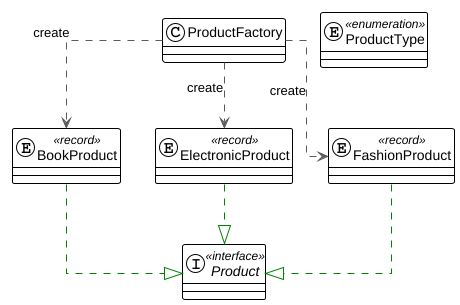
Our scenario here is a simple one: a Product interface implemented by three
classes: BookProduct, ElectronicProduct and FashionProduct. They can be
created through the ProductFactory class, as follows:
public class ProductFactory
{
  public static Product newProduct (String name, String description, BigDecimal price, ProductType productType)
  {
    Objects.requireNonNull(name, "Name is null");
    ...
    return switch (productType)
    {
      case BOOK -> new BookProduct(name, description, price);
      case ELECTRONIC -> new ElectronicProduct(name, description, price);
      case FASHION -> new FashionProduct(name, description, price);
      default -> throw new IllegalArgumentException ("Unknown type: %s".formatted(productType));
    };
  }
}
Using this factory, it’s very easy to create a BookProduct, for example, while
avoiding to expose implementation details:
    ...
    Product product = ProductFactory.newProduct("Book1", "A book",
      new BigDecimal("20.50"), ProductType.BOOK);
    ...
As you probably noticed, the ProductType enumerated defines the three categories.
If a new product is to be introduced, the factory has to be modified such that to
reflect this business changement. And this interdependence of the factory and the
enumerated makes the whole approach fragile.
In order to reduce this fragility, we need to introduce a compile-time validation with a more functional approach.
The functional approach
Our example is an over-simplified case of a product management system. The presented
factory instantiate different simple records having the same arguments. These
identical constructors give us the possibility to move the factory directly into
the ProductType enumerated, such that any new product automatically requires
a correspondent factory.
Java enum types are based on constant names, but we can attach to each one its
correspondent value. Or, even better, a factory function for creating discrete
products. Look at that:
public enum ProductType
{
  ELECTRONIC(ElectronicProduct::new),
  FASHION(FashionProduct::new),
  BOOK(BookProduct::new);

  public final TriFunction<String, String, BigDecimal, Product> factory;

  ProductType (TriFunction<String, String, BigDecimal, Product> factory)
  {
    this.factory = factory;
  }

  public Product newInstance (String name, String description, BigDecimal price)
  {
    Objects.requireNonNull(name, "Name is null");
    ...
    return this.factory.apply (name, description, price);
  }
}
Now, creating a new Product instance is easier:
Product product = ProductType.BOOK.newInstance("Book1",
  "A book", new BigDecimal("20.45"));
The public property factory seems redundant now that a dedicated method for the
instance creation is available. But it provides a very convenient functional way
to interact further with the factory. For example:
ProductType.BOOK.factory.andThen(showThePrice).apply("Book1",
  "A book", new BigDecimal("20.45"));
as shown in the TestProductFactory class, in the fp_design_paterns.factory
package. Of course, given that our products need three arguments constructors and
since Java doesn’t provide an equivalent of the BiFunction class, but with three
input arguments, you will need to craft a TriFunction class, as shown below:
@FunctionalInterface
public interface TriFunction<A, B, C, R>
{
  R apply(A a, B b, C c);
  default <K> TriFunction<A, B, C, K> andThen(Function<? super R, ? extends K> f)
  {
    Objects.requireNonNull(f);
    return (A a, B b, C c) -> f.apply(apply(a, b, c));
  }
}
You can do that or, if like me, you prefer to use a reliable library, then Vavr
already defines a Function3 interface that has the behavior you want. Just
include the following Maven dependency:
<dependency>
  <groupId>io.vavr</groupId>
  <artifactId>vavr</artifactId>
  <version>1.0.1</version>
</dependency>
This library is the good choice if you need to define functions with up to 8
arguments. Then, you just need to replace, in ProductType, the following
definition:
public final TriFunction<String, String, BigDecimal, Product> factory;

ProductType (TriFunction<String, String, BigDecimal, Product> factory)
{
  this.factory = factory;
}
bvy this one:
public final Function3<String, String, BigDecimal, Product> factory;

ProductType (Function3<String, String, BigDecimal, Product> factory)
{
  this.factory = factory;
}
The full code of these examples, including the associated unit tests, can be found here: https://github.com/nicolasduminil/oop-fp-design-patterns.