
Rethinking Java Design Patterns: from OOP to FP (2)
In a previous post, we’ve looked at how to combine the Java’s object oriented and functional styles to implement a new and modern Factory design pattern. After this creational pattern, let’s continue with a behavioral one: the Visitor.
The Visitor
This design pattern belongs to the behavioral category and its purpose is to add new operations to an existing object hierarchy without modifying the classes of that hierarchy. It is the classic answer to the expression problem: when the set of types is stable but the set of operations grows, the Visitor lets you keep adding operations cheaply.
We reuse the same domain as the factory: a Product implemented by BookProduct,
ElectronicProduct and FashionProduct. To give the visitor a reason to exist,
each operation now behaves differently per product type:
- VAT: a reduced 5.5% rate for books, the standard 20% rate otherwise.
- Shipping:
10.00 + 2%of the price for fragile, insured electronics, a flat3.00for books and a flat5.00for fashion. - Discount: 10% for electronics, 5% for books, 15% for fashion.
The object-oriented approach
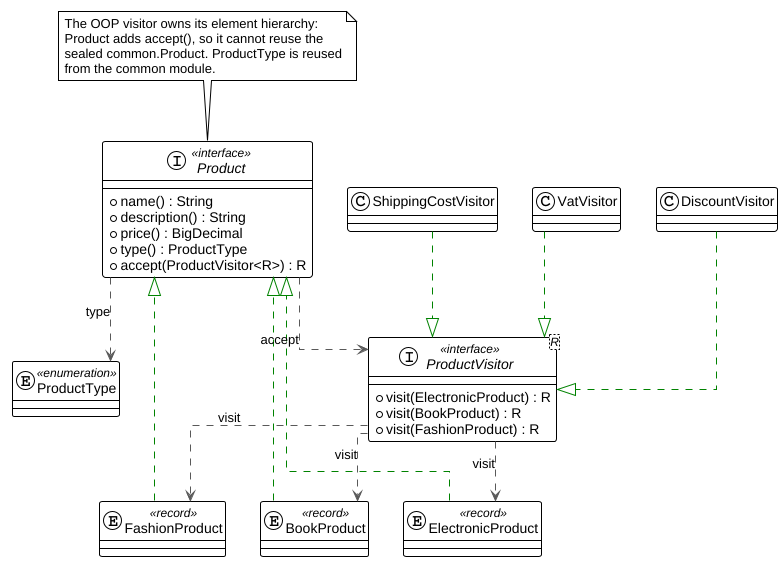
The classic Visitor relies on double dispatch. Each Product accepts a visitor
and calls back the overloaded visit(...) matching its own type
public interface Product
{
  ...
  <R> R accept(ProductVisitor<R> visitor);
}

public record BookProduct (String name, String description, BigDecimal price) implements Product
{
  ...
  public <R> R accept(ProductVisitor<R> visitor)
  {
    return visitor.visit(this);
  }
}
The operation lives in a generic visitor, one visit(...) overload per concrete type:
public interface ProductVisitor<R>
{
  R visit(ElectronicProduct product);
  R visit(BookProduct product);
  R visit(FashionProduct product);
}
Computing the VAT of any product is then a matter of applying a concrete visitor:
BigDecimal vat = book.accept(new VatVisitor());
Adding a new operation only requires a new ProductVisitor class while
the Product implementation ones never change. However, we need to notice that,
as the reverse of the trade-off the factory made, adding a new operation is easy
but adding a new product type is expansive since it requires to edit its central
switch. The visitor makes adding a new operation free but shifts that same
cost onto types, because a new product type now forces every visitor to be updated.
This is the classic expression problem: you can make types cheap to add or
operations cheap to add, but not both.
The following figure below shows the object-oriented implementation class diagram:
The functional approach
Look now at the class diagram of the Vistor functional style implemntation:
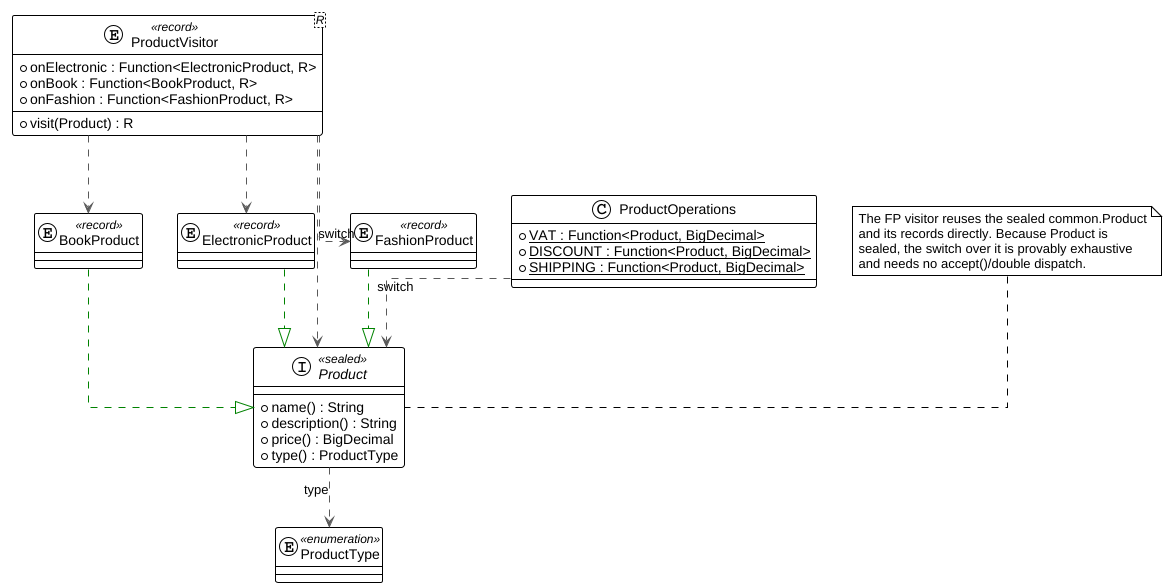
In modern Java the functional counterpart of the Visitor is exhaustive pattern matching over a sealed type. We first seal the hierarchy:
public sealed interface Product permits ElectronicProduct, BookProduct, FashionProduct
{
  ...
}
An operation is then just a Function<Product, R> built on a switch that
deconstructs each record. Because Product is sealed, the compiler proves the
switch is exhaustive - no default branch, no double dispatch, no accept:
public static final Function<Product, BigDecimal> VAT = product -> switch (product)
{
  case BookProduct(String name, String description, BigDecimal price) -> amount(price, "0.055");
  case ElectronicProduct(String name, String description, BigDecimal price) -> amount(price, "0.20");
  case FashionProduct(String name, String description, BigDecimal price) -> amount(price, "0.20");
};
Being ordinary functions, these operations can be composed:
ProductOperations.DISCOUNT.andThen(amount -> "discount=" + amount).apply(fashion);
Between the classic Visitor and pure pattern matching sits an intermediate step: the visitor as a bundle of functions, one lambda per type, instead of an interface with one method per type:
public record ProductVisitor<R>(
  Function<ElectronicProduct, R> onElectronic,
  Function<BookProduct, R> onBook,
  Function<FashionProduct, R> onFashion)
{
  public R visit(Product product)
  {
    return switch (product)
    {
      case ElectronicProduct e -> onElectronic.apply(e);
      case BookProduct b -> onBook.apply(b);
      case FashionProduct f -> onFashion.apply(f);
    };
  }
}
Which makes an operation a value you can assemble on the fly:
ProductVisitor<BigDecimal> vat = new ProductVisitor<>(
  e -> ..., b -> ..., f -> ...);
BigDecimal amount = vat.visit(book);
Of course, you may find these examples in the same GitHub repository as the previous factory pattern. It has been reorganized as a multi-module Maven project.
The product domain lives now in its own common module containing a sealed
Product interface, the three product records and the ProductType enumerated
which already carries the FP factory function seen above.
Everything that can reuse that domain does:
oop-fp-design-patterns        (parent POM)
├── common                    sealed Product, the records, ProductType(+factory)
├── factory   (→ common)      ProductFactory (OOP); the FP factory *is* common.ProductType
└── visitor   (→ common)      FP: operations over the common records (switch + lambda bundle)
                              OOP: its own element hierarchy (see below)
The FP factory and the FP visitor both operate directly on the common records,
so nothing is duplicated there. The one exception is the object-oriented
Visitor which needs an accept method on every product type, for the double dispatch.
Since common.Product is sealed it cannot be extended from another module.
The OOP visitor therefore owns its product hierarchy and reuses only the
ProductType enumerated. That asymmetry is not accidental.
The classic Visitor requires every product type to expose an accept method, which
couples them to the visitor abstraction. Accordingly, each product type must be
defined in sync with it and so cannot be the sealed common records. The functional
approach has no such coupling. It pattern-matches over the sealed type from the
outside, so the products know nothing about the operations applied to them and
can stay the shared common records.